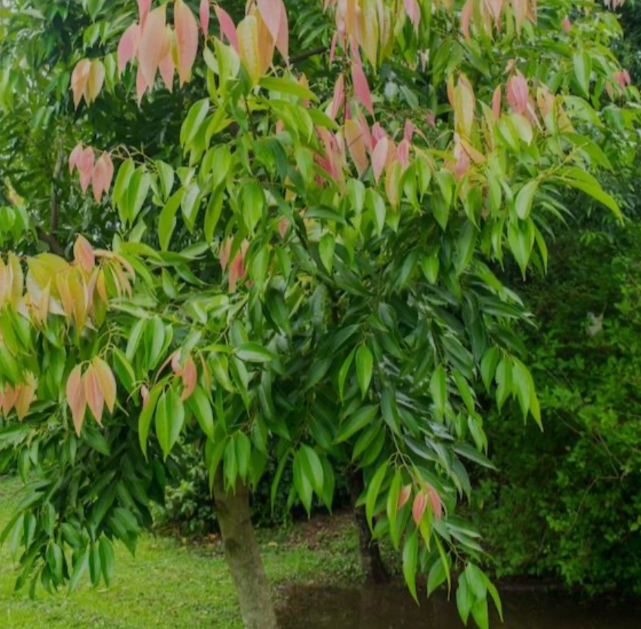
natural cinnamon plant Cinnamon Tree
SKU: 22593794609
natural cinnamon plant

natural cinnamon plant Cinnamon Tree

Sale price$21.86 Regular price$24.29
Save 10%

Shipping Estimate
USA
  • USA
  • CAN

Ships within 48 hours · Estimated delivery Jul 7 - Jul 12

Promo Codes Available:

For Your Every Summer RSVP, with Code: SUMMER15

Description

natural cinnamon plant Cinnamon TreeCinnamon Tree (Cinnamomum zeylanicum) Overview The Cinnamon Tree, scientifically known as Cinnamomum zeylanicum, is a tropical evergreen tree native to Sri Lanka, India, and other parts of Southeast Asia. It is best known for the spice cinnamon, which comes from the bark of the tree. The tree has aromatic leaves and produces small, yellowish flowers, which are followed by small berries. The taste of cinnamon derived from this tree is sweet, warm, and

Cinnamon Tree (Cinnamomum zeylanicum) Overview

The Cinnamon Tree, scientifically known as Cinnamomum zeylanicum, is a tropical evergreen tree native to Sri Lanka, India, and other parts of Southeast Asia. It is best known for the spice cinnamon, which comes from the bark of the tree. The tree has aromatic leaves and produces small, yellowish flowers, which are followed by small berries. The taste of cinnamon derived from this tree is sweet, warm, and slightly spicy, with a distinct, fragrant aroma that is unmistakable in both culinary and medicinal applications.

Taste Profile

The flavor of cinnamon from Cinnamomum zeylanicum, also called "true cinnamon," is generally more delicate and sweet compared to its more common counterpart, Cinnamomum cassia. True cinnamon has a mild, complex flavor profile with subtle hints of citrus and clove. This makes it a popular choice for both sweet and savory dishes, as well as for use in traditional medicine. The texture of the bark, which is typically thinner and softer than cassia, also contributes to its superior culinary reputation.

Best Growing Environment

Cinnamon trees thrive in warm, humid environments with rich, well-drained soils. They prefer areas that provide consistent temperatures between 65F and 95F (18°C - 35°C), and they require high humidity to mimic their native tropical climates. The trees are not cold-tolerant, making them unsuitable for regions with frost or freezing temperatures. Ideally, cinnamon trees grow in sheltered, partly shaded locations to protect them from the harsh midday sun, though they can tolerate full sun if grown in tropical or subtropical areas.

Common Names

  • True Cinnamon
  • Cinnamomum verum
  • Cinnamomum zeylanicum (historically used, though this is a synonym)

Average Height and Growth Rate

Cinnamon trees can grow to a height of 30 to 40 feet (9 to 12 meters) in their natural environment, though they can be pruned to maintain a more manageable size for cultivation or ornamental purposes. In ideal conditions, these trees have a relatively fast growth rate, typically gaining 1 to 2 feet (30 to 60 cm) of height per year during the growing season, especially when young.

Sun Requirements

Cinnamon trees generally prefer partial shade in areas with intense sun, though they will tolerate full sun if grown in regions where high humidity and sufficient water are available. When grown indoors, it is essential to provide bright, indirect light or place the tree in a location that receives filtered sunlight.

Cold Hardiness

Cinnamon trees are highly sensitive to cold. They grow best in USDA zones 9b-12 and cannot survive freezing temperatures. A drop in temperature below 50F (10°C) can cause significant damage, and frost will kill the tree, so it requires frost protection in the Tampa Bay area. In non-tropical climates, cinnamon trees can be grown indoors or in greenhouses, where temperatures can be regulated.

Water Requirements

Cinnamon trees require consistent moisture and thrive in humid environments. The soil should be kept moist but not soggy. Overwatering can lead to root rot, so good drainage is essential. During the growing season, water the tree regularly, especially during dry spells. In winter, when the tree's growth slows, reduce watering but ensure the soil doesn't dry out completely. If grown indoors, maintaining humidity through misting or a humidity tray can help the tree stay healthy.

Planting Guide

When planting a cinnamon tree, choose a well-drained, fertile soil. If planting in the ground, ensure the site is free from frost and provides adequate space for the tree’s roots to spread. If growing in a container, use a large pot with drainage holes, and select a soil mix that retains moisture but doesn't become waterlogged.

  1. Planting Location: Choose a sunny location or partial shade, preferably with protection from harsh winds.
  2. Soil Requirements: The soil should be slightly acidic to neutral (pH 6.0-7.0) and rich in organic matter.
  3. Planting Depth: Dig a hole large enough to accommodate the root ball, and ensure the top of the root ball is level with the ground. If growing in a container, place the tree in a pot that is 2-3 inches (5-8 cm) larger in diameter than the root ball.
  4. Spacing: If planting multiple trees, space them at least 10 feet (3 meters) apart to allow for mature growth.

Fertilization Schedule and Recommendations

Cinnamon trees require a balanced fertilizer to promote healthy growth and bark production. Fertilizing should be done in early spring, when the tree starts actively growing, and continued through mid-summer. Here’s a recommended fertilization schedule:

  • Spring (March - April): Apply a balanced fertilizer like 10-10-10 (NPK) or a slow-release organic fertilizer to promote overall growth.
  • Summer (June - July): Apply a second round of fertilizer to support the ongoing growth cycle, particularly if the tree shows signs of nutrient deficiency (e.g., yellowing leaves).
  • Fall (September): If necessary, apply a light dose of a potassium-rich fertilizer to help the tree prepare for the cooler months and promote strong bark formation.
  • Winter (December - February): No fertilizing is needed during the winter months, as the tree's growth slows down significantly.

It is essential not to over-fertilize cinnamon trees, as this can lead to excessive leaf growth at the expense of bark production.

USDA Hardiness Zones

The cinnamon tree is best suited to USDA hardiness zones 9b through 12. In these zones, the temperatures remain warm year-round, with minimal risk of frost or freezing temperatures. For gardeners in colder climates, cinnamon trees can be grown in pots and moved indoors during the winter months.

Shipping Notes
  • Free Standard Shipping on $100+ Orders to the USA.
  • Except Preorder products are shipped in 48 hours.
  • Delivery to the USA:
  1. Standard Shipping : 3-10 business days
  • If time is of the essence, please consider selecting expedited delivery for faster service.
Exchange/Return Notes
  • We offer a 30-day return/exchange service after receiving.
  • Final sale items are not eligible for returns or exchanges.
  • To process your return/exchange, please contact us at [email protected]
  • Please click here for more details>>> Return & Exchange Policy
SKU: 22593794609

Discover Niche Categories That Outsell natural cinnamon plant

Top-Converting Item to Boost Your Average Order

4.3 ★★★★★
Based on 2466 reviews
Sort
Highest Rating
Newest First
Oldest First
Product Reviews
P
Verified Purchase
Plato's Cat
Draper, US
★★★★★ 5
Dr. Woollacott’s bold and fascinating book breaks new ground ...
Format: Hardcover
Dr. Woollacott’s bold and fascinating book breaks new ground in the current debate about whether consciousness is created by the physical brain, or whether consciousness is “primary,” an elemental force that exists independently from the brain. What impressed me is that I could view her book through two very different perspectives: it’s at once both scholarly and a very enjoyable read. As I read her book, I found myself going back and forth between enjoying the stories and examples she provided, and the scientific evidence and analysis she offers. I was truly surprised to see that there are quite a few MD’s, psychologists, and neuroscientists doing rigorous, peer-reviewed research into these areas. Dr. Woollacott not only summarizes this research very clearly but provides many compelling case-studies quoted in this research that seem impossible to explain in terms of our current understanding of the brain. In addition to crafting a careful and thoughtful review of the research that supports the reality of NDEs, reincarnation, and energy healing, Dr. Woollacott also describes some of her own highly mystical experiences. This is perhaps one of the strongest elements in a book that has many compelling aspects to it. By telling her own story of being “awakened” by an Indian swami and of then having classic mystical experiences that most of us think could only have happened “way back when,” she adds her own impressive data point to the discussion about the nature of consciousness. I was fascinated to see how this experience was so powerful that it instantly turned her from an atheist into a person who knew beyond doubt that “something else” was going on. But then again, almost all the stories in this book were both dramatic and convincing. I wouldn’t be surprised if this becomes one of those “milestone” books. The research she surveys and the personal transformation she shares are dramatic enough and credible enough to provoke intense conversation and debate. It’s hard to ignore what you’ll read in this book (unless you’re a scientist who prefers belief to data). As they say, once you’ve seen this material, you can’t unsee it.
WAS THIS REVIEW HELPFUL?YesReportShare
Reviewed in the United States on November 9, 2015
B
Verified Purchase
Barbara Reid
West Palm Beach, US
★★★★★ 5
A Match Made in Heaven
Format: Hardcover
Marjorie Woollacott has provided the world with an incredible opportunity. The opportunity of merging two parallel universes; the scientific exploration of the brain, mind, consciousness, and awareness with the inner journey of one’s spiritual path of yoga and meditation. Marjorie has had her feet firmly walking the path of science and meditation for over 40 years. She gives her readers what they have been wanting for decades which is a readable resource to understand the complex scientific research of neuroscience and to understand the ancient texts of yoga and meditation. She eloquently explains to the readers how these two worlds were so far apart, and are now communicating and working together to solve the glorious mysteries of the mind, the brain and meditation. This is a match made in heaven. Deep exploration of the mental and spiritual bodies allow the readers to revel in these mysteries and begin to appreciate the unlimited vastness of a human birth. I loved this book and bought the Kindle version, but now realize this is a book I need to have in print so I can easily revisit sections which are worth future contemplation.
WAS THIS REVIEW HELPFUL?YesReportShare
Reviewed in the United States on January 7, 2016
B
Verified Purchase
big beef
Chelsea, US
★★★★★ 4
For open minded scientists
Format: Kindle
The author expands the world of neuroscience,moving outside the materialist box that limits consciousness to brain activity. Well researched and fascinating.
WAS THIS REVIEW HELPFUL?YesReportShare
Reviewed in the United States on September 23, 2017
M
Verified Purchase
Martin E. Schmidt
Lexington, US
★★★★★ 5
An award-winning book exploring the relationship of science and spirituality
Format: Hardcover
This highly engaging, award-winning book is the best introduction for non-specialists that I’ve come across that offers an intelligent alternative to the existential meaningless implicit in the materialist paradigm. Woollacott, a recently retired neuroscientist, takes readers on her quest to reconcile the objective world of her scientific study with the meditation experiences of her personal life. For most of her career, Woollacott kept her subjective experiences separated from scientific work. Having now retired from active scientific research, she now explains in this book how she came to construct a coherent worldview which synthesizes quantum physics, Hindu philosophy, and her own meditation practice. Having read numerous books in this genre, I most appreciated her intelligent exposition of scientific studies for the non-specialist, explaining how she came to favor panpsychism over materialism, all framed within her own life-long journey towards answering life’s biggest questions. I will gladly return to this book frequently as I try to help students consider an alternative to the materialist paradigm.
WAS THIS REVIEW HELPFUL?YesReportShare
Reviewed in the United States on December 29, 2018
J
Verified Purchase
Jerry Yudelson
Boise, US
★★★★★ 5
An Indispensable Guide to the Scientific Argument about the Primacy of Consciousness throughout the Universe!
Format: Hardcover
I couldn't put down this book! It's a fascinating account of one scientist's personal and professional journey to the heart of the mind/brain problem: which is primary? Marjorie Woollacott's account of her own scholarly research and her attempts to integrate her profound experiences of perfect awareness through the path of meditation is a tale for our times. She clearly shows the deficiencies of the current scientific model that postulates that awareness is only a function of brain activity, but more than that she integrates modern physics, in the form of quantum mechanics, with the ancient wisdom of the seers of her chosen spiritual tradition, Kashmir Shaivism, and voila! shows them to be identical in essence, if not in expression. As more people pursue meditation practice as a way to generate deep insights into consciousness, Dr. Woollacott's book is an indispensable guide to the contemporary scientific discussion around these issues. The case studies are moving and her personal journey is just as bold as her scientific work must be. This is "the book of a lifetime" for her, the culmination of years of research, study and contemplation. Bravo!
WAS THIS REVIEW HELPFUL?YesReportShare
Reviewed in the United States on January 23, 2016

recommand products